

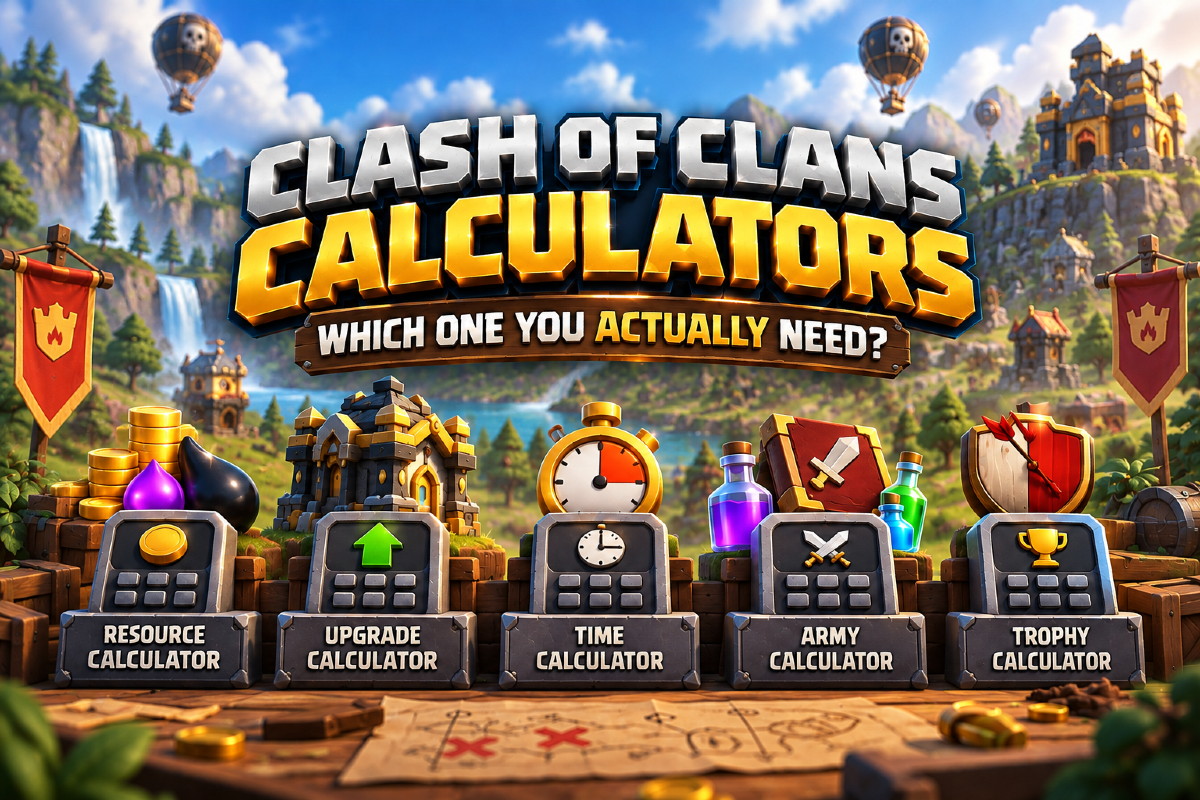
If you searched "coc calculator" you almost certainly want one of five things: how long the rest of your Town Hall will take, what a gem pack actually costs in real money, how much dark elixir your army drains per attack, how much loot you need to bank, or why your war matchmaking feels broken. Each of those is a different tool. Pick the right one and you get an answer in seconds; pick the wrong one and you get a number that doesn't apply to your account.
This page explains what each calculator type does, what inputs it needs, and where the output lies to you.
The five calculator types, and when to use each
| Calculator | Answers | Use it when |
|---|---|---|
| Upgrade cost & time | Total gold, elixir, dark elixir and builder days left to max your current Town Hall | You're planning a Town Hall stay or deciding whether to rush |
| Gem / real-money | What a gem purchase costs per gem in your currency, and what a boost or skip is worth | Before you spend money, or before you burn a gem stash on a builder |
| Army cost & training | Elixir, dark elixir and training time for a specific army composition | You're picking a farming army and want the cheapest one that works |
| Loot & farming | How many raids at your average loot per hit to reach a target upgrade | You're grinding for one specific building or hero level |
| War weight | Roughly how heavy your base is for clan war matchmaking | Your clan keeps getting mismatched and you want to know who's causing it |
Upgrade cost and time calculators
This is the one most people mean. You tell it your Town Hall level and the current level of every building, trap, hero and lab item; it returns the remaining resource totals and the builder-days required to finish.
Two things determine whether the output is worth anything.
It must know your builder count and Builder Apprentice status
Total builder time divided by builders is the only figure that matters for planning. A calculator that reports a single lump of "days" without asking how many builders you have is giving you a number you then have to divide yourself - and if you have the Builder Apprentice or an extra builder from the Builder Base, the real finish date moves substantially. Always enter your actual builder count.
It must separate lab, hero and building queues
Your laboratory, your heroes and your builders run on parallel tracks. A calculator that adds lab time to builder time and shows you one grand total is misleading - your lab keeps running while your builders work, and hero upgrades occupy a builder but block that hero from war. Look for a tool that shows three separate timelines. The longest of the three is your real Town Hall stay length.
How to read the result
Treat the resource total as the honest number and the time total as the optimistic one. The resource figure is fixed. The time figure assumes you never idle a builder, never sit at max storage waiting for a decision, and never lose a day to a magic item you're saving. Add slack.
Gem and real-money calculators
These convert a gem pack price into cost-per-gem, then let you price out an action - finishing an upgrade, buying a builder hut, boosting barracks - in your own currency.
The useful output isn't the total, it's the comparison. Cost-per-gem is not flat across packs, so a gem calculator's job is to tell you which pack size is the best rate and how far a given stash actually goes. Regional pricing and store taxes vary, so enter the price your store shows you rather than trusting a preset.
One decision rule that holds regardless of the numbers: gems spent on a permanent builder return value for the entire life of the account, gems spent skipping a single upgrade return value once. If you're only going to spend once, spend it on a builder.
Army cost and training calculators
You build a composition - troops, spells, siege machine, Clan Castle - and the tool returns total elixir, dark elixir and training time.
What you're actually testing is profitability. A farming army only makes sense if the average loot it pulls exceeds what it costs to rebuild, and dark elixir troops are where armies quietly go negative. Run two compositions through the calculator side by side, then compare each against the loot you typically take from a raid at your trophy range. The cheaper army wins ties, because with training potions and a full queue your bottleneck is almost never training time - it's elixir.
Spells are the line item people forget. Add the spell cost before you judge an army as cheap.
Loot and farming calculators
These take a target - a hero level, a specific building, a full Town Hall - and your average loot per raid, and return how many raids stand between you and it.
They're only as good as your loot-per-raid input, so don't guess it. Do ten raids, note the storages after, divide. Then apply the two adjustments almost every player forgets:
- League bonus and Star Bonus. Your per-raid average from storages doesn't include them unless you counted them. At higher leagues the bonus is a real slice of daily income.
- Clan Games and event rewards. Resource magic items compress a grind badly. If a calculator says your target is weeks away, a couple of Books and Runes can cut that dramatically - so recompute after every Clan Games.
War weight calculators
War weight is an internal matchmaking value derived from what you've upgraded - defences and traps push it up hard, offence contributes far less. A war weight calculator estimates yours from your building levels so a clan can see who is dragging the roster.
Be honest about the limits here. Supercell has never published the exact weighting, so every war weight tool is a community-built estimate. Use it comparatively - to spot which member is heaviest relative to their attack power - and not as an absolute score. The actionable conclusion is almost always the same: a rushed base with high defences and weak heroes is what breaks a war roster, and the fix is heroes and lab, not more defences.
Which calculator to use for the decision you're making
"Should I rush to the next Town Hall?"
Upgrade cost calculator, set to your current Town Hall, with hero and lab timelines shown separately. If your lab and hero timelines are far longer than your builder timeline, moving up doesn't help - you'd be adding buildings you can't fund while your real bottleneck stays put. Finish heroes first.
"Is this gem pack worth it?"
Gem calculator with your local store price entered manually. Compare cost-per-gem across pack sizes, then price the specific thing you want in real currency and decide on that figure, not on the gem figure.
"Which farming army should I run?"
Army cost calculator, two compositions, spells included. Cheapest one that reliably takes the loot you're after.
"How long until my hero is maxed?"
Loot calculator, using your measured dark elixir per raid including Star Bonus. Recompute after Clan Games.
"Why do we keep getting mismatched in war?"
War weight calculator across the full roster, used comparatively. Look for high-defence, low-hero accounts.
Common mistakes that produce garbage output
- Entering your Town Hall level and nothing else. Every calculator that matters needs your individual building levels. A Town Hall level alone gives you a max-from-scratch figure, which is wrong for anyone who has already upgraded anything.
- Ignoring walls. Walls are usually the single largest gold sink at a Town Hall and they don't occupy a builder, so they never show up in your builder timeline. Check whether the tool includes them in the resource total; if it excludes them, your gold requirement is understated.
- Using a calculator built for an older Town Hall. Content updates add buildings, levels and lab tiers. If a tool doesn't list your newest defences, its totals are stale.
- Treating time as a hard deadline. Builder idle time, storage caps and indecision all inflate the real number. The resource total is the trustworthy half of the output.
- Forgetting the Builder Base and Clan Capital. They run on separate resources and separate builders. Don't fold them into your Home Village plan.
Building your own quick estimate without a tool
If you just want a rough Town Hall stay length and don't want to enter fifty buildings, do this: open your build queue mentality instead. List the upgrades you actually care about - heroes, lab, key defences, walls - ignore the rest, and total only those. Most players over-plan by including every wall segment and every decoration-tier building. The upgrades that gate your progress are heroes, lab and storages. Everything else fills in around them.
Then set your target as "heroes and lab done" rather than "everything maxed". That's the version of maxing that changes how your account performs, and it's the number a calculator should be helping you hit.